


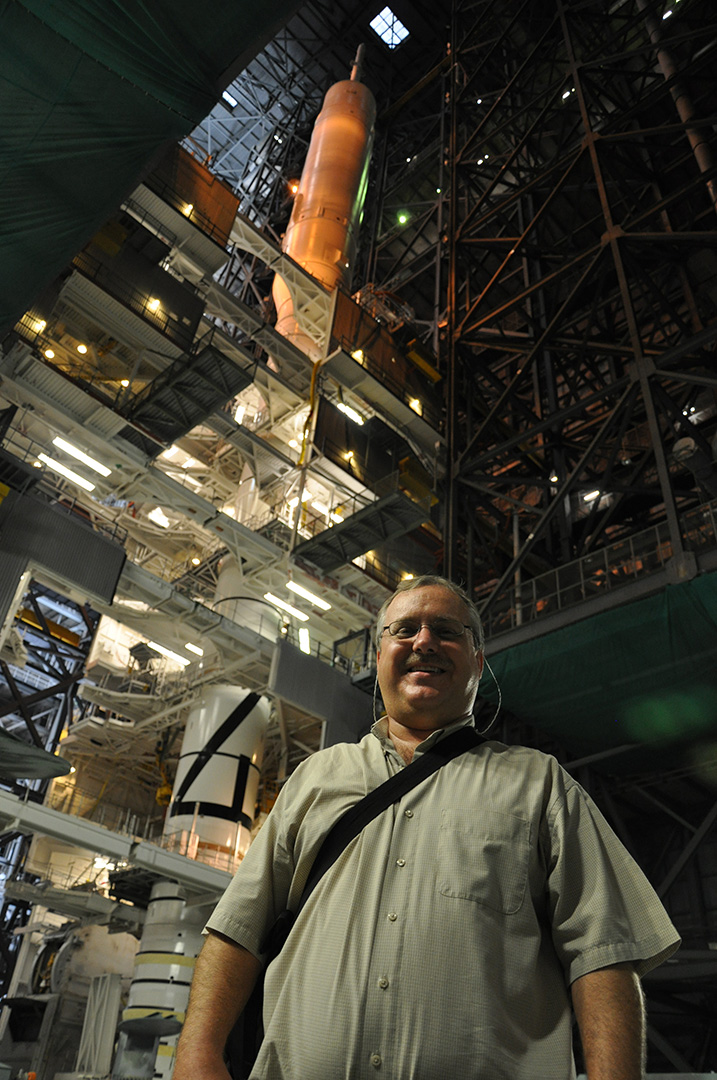
Jim Kania – Computer engineer who helped NASA reach for the stars
Jim Kania (Florida Tech ’96) recently retired from a 30-year career at NASA working on computer software systems that would drive some of the most influential space programs, including a few that will help return U.S. astronauts to the surface of the moon.
A lifelong sci-fi fan, Jim was always fascinated by space and dreamed of working for NASA. After high school, his trek to a career in space exploration seemed to be light years away. He got a job working in the data center of a bank, but it was always in the forefront of his thoughts that he could do better and chase his dream.
“Houston, we have a Pilam.”
Jim gained some valuable experience at his bank job which would help him to enroll at Florida Tech to pursue an advanced degree. He said, “I had a plan. If you really want to get into a career or a competitive field that interests you, you need to have a plan. I did the leg work, and I saw that Florida Tech was the university that would work.”
Florida Tech offered a unique curriculum of classes that were space-oriented, including one called “Processing Space Launch Systems” that was taught on Patrick Air Force Base. Jim quickly made some key contacts at college and wound up working several cooperative education program (co-op) tours at NASA which lasted from 1992-96.
After a brief detour in the private sector working at Rockwell Collins, a friend working at NASA referred Jim to a “job with his name on it” as a software quality engineer. It launched him into an exciting full-time career at NASA’s Kennedy Space Center.
Making a Deep Impact on NASA projects
Jim was pleased to find that NASA provided a lot of opportunity to work on a diverse collection of projects that were both experimental and operational. He’s proud of the role he played in software quality and engineering for some of the space agency’s notable programs. These programs helped to test and further develop technology that would contribute to the ongoing advancement of space travel.



Spacelab and the International Space Station
Spacelab was a reusable space laboratory built by the European Space Agency (ESA) that flew in the cargo bay of the Space Shuttle. Operating from 1983 to 1998, it allowed scientists to conduct hundreds of experiments in low-Earth orbit.
The program created a wealth of space experimental data, and facilitated around 800 experiments in microgravity, laying the scientific and engineering groundwork for the International Space Station (ISS). Jim said, “I was part of the team that processed Spacelab Payload experiments for flight using test and assembly procedures.” Today, the legacy of Spacelab lives on through the much larger ISS, where Jim worked on payload processing software quality.
During Jim’s time on the ISS Program, he led a team of NASA engineers that wrote the NASA Software Assurance Standard. He also contributed to the development of the NASA Software Engineering Requirements as KSC representative on the NASA Software Working Group. These efforts led to establishing, standardizing, and improving software engineering and management practices across all NASA centers.
Constellation Program and the Launch Control System
Jim developed program requirements for the Constellation program which was proposed to replace the Space Shuttles that were retired in 2011. The new program was started in 2005 to return humans to the Moon and establish a stepping stone for future crewed missions to Mars. Though it was canceled in 2010 for budgetary overruns, the work done would be used to benefit future programs.
During this time Jim was also the Software Assurance Engineer on the Launch Control System (LCS) project, which evolved into the Launch Control System used for the Artemis Program.
Prospecting for water on the Moon
After supporting the ISS, Constellation, and Space Shuttle Programs, Jim worked on In-Situ Resource Utilization (ISRU) projects to develop systems that would allow astronauts to extract and process local resources on the Moon, Mars, and asteroids to produce breathable air, water, and rocket propellant instead of launching these heavy supplies from Earth.
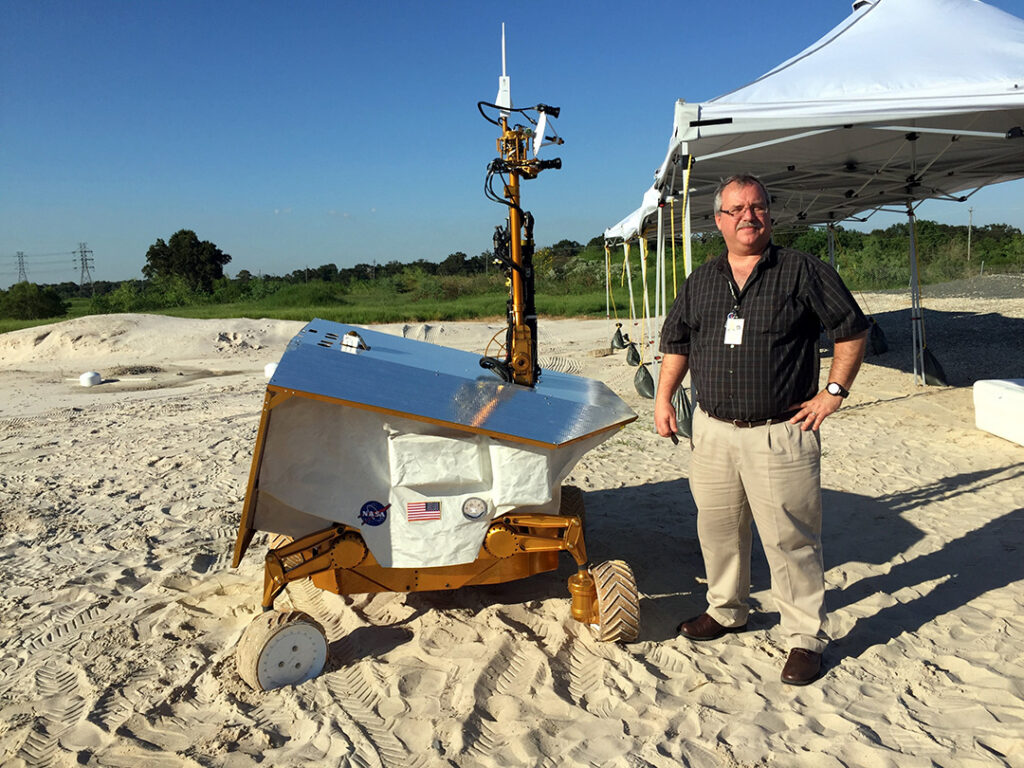
These projects included the Resource Prospector rover, the MSolo (Mass Spectrometer observing lunar operations) instrument, and the IPEx (ISRU Pilot Excavator) rover. The MSolo mass spectrometer became one of the primary instruments on the NASA VIPER (Volatiles Investigating Polar Exploration Rover), a lunar robotic rover designed to explore the Moon’s South Pole, locate water ice, and map potential resources to sustain long-term human exploration.
Jim said, “We developed a software control system that would command the MSolo instrument, and receive and process the data.” The MSolo instrument is a compact, ruggedized commercial off-the-shelf mass spectrometer developed to detect water and other volatile gases on the Moon. The Artemis astronauts who land on the Moon will use it to help locate resources that can be converted into drinking water, breathable oxygen, and rocket fuel. MSolo successfully demonstrated its gas analysis capabilities in lunar conditions during Intuitive Machines’ IM-2 mission in 2025.
To the Moon and beyond!
Jim is proud of his contributions to numerous projects that had developmental and long-term impacts on space exploration and is excited for the future. Asked what he thought about the renewed enthusiasm generated to the space program by the recent Artemis 2 mission Jim said, “It’s really cool. It gives the American public confidence that NASA can succeed. I’m looking forward to the rest of the lunar campaign.”
In his heart, Jim will always be a space fanboy. He relished not only his work at NASA, but the opportunities it presented him to touch space. He said, “I used to go out on the launch pad all the time. I’d go up to the top of the launch tower, where the astronauts board the Space Shuttle. The view from up there was incredible. You can see the ocean, the Vehicle Assembly Building, and the other launch pad. It was so cool just being in such proximity with all that space hardware. Being a part of the U.S. Space Program was what I always dreamed about when I was growing up.”
Why Pilam?
When Jim attended Florida Tech, he was enjoying his freshman year and being rushed by a number of fraternities, including Pilam. Sadly, Jim’s father passed away from cancer and Jim returned home to spend time with his family.
Jim said, “When I went back home to the funeral, the FL Delta Upsilon brothers sent a card and flowers for the service. I immediately decided which fraternity I would join. It was a good group of guys.”


He enjoyed his undergraduate days in Pilam and served as the chapter historian saying, “I took hundreds of photos over the years and created huge scrapbooks. We had a lot of fun, and we also did a lot of good through our efforts in philanthropy.”
Jim still attends annual FL Delta Upsilon Alumni Weekends. He’s looking forward to the celebration of the 35th anniversary of the chapter’s founding next year in Key West.