


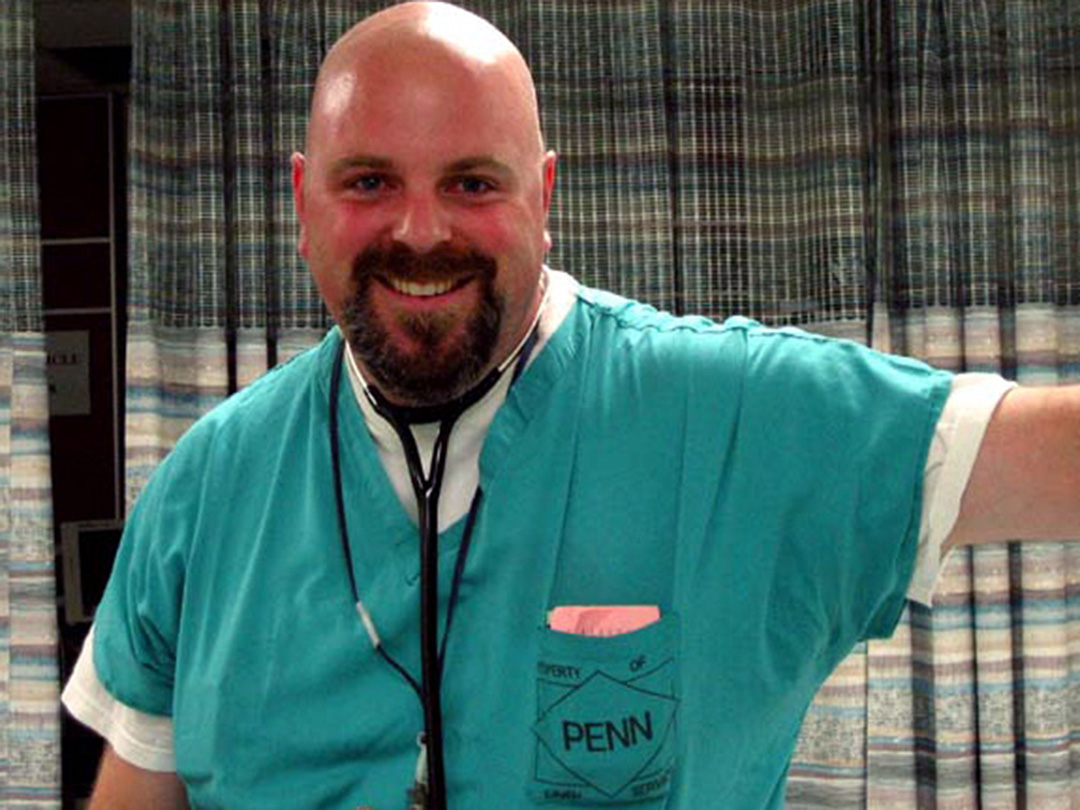
Chris Doty, MD – Emergency Medicine doctor and mentor. Read his story, STAT!
Christopher Doty, MD (U of Delaware ’93) has spent his life caring for patients and saving lives in the emergency room, while passing on his knowledge and experience to the next generation of ER professionals.
He is Pilam’s real-life “Dr. Robby” from the HBO medical drama, The Pitt.
His path to helping people


Doty’s biggest inspirations were his parents. He said, “My mom was a giver her whole life. She was a social worker and became a lobbyist for Common Cause, an organization that tries to create equality and ensure the democratic process for people. She eventually became an ordained pastor in the Presbyterian Church. She lived a life of service to people.”
He continued, “My dad was very analytical and enjoyed math and science. I was good at math and science, so I just tried to combine those gifts from my father with the desire to help people from my mom.”
At 14 years-old, Chris joined the local volunteer fire company and eventually became an EMT, firefighter, and a paramedic.
When the student becomes the teacher
Chris went to medical school at Thomas Jefferson University in Philadelphia. He did his residency in Brooklyn at Kings County Hospital, where he stayed on as faculty for about ten years, seeing patients with medical students and residents saying, “I would practice medicine and teach at bedside simultaneously.”
He liked the idea of teaching because, “I can contribute to the next generation of emergency physicians. It’s about leaving a legacy. I like the idea that I can help somebody achieve their goals and attain their greatness. And when I look at my career of teaching residents, many of those people are doing amazing things.”
Chris is currently the Vice Chair for the Department of Emergency Medicine at the University of Kentucky College of Medicine with the primary responsibility of the academic side of the department.
Challenges of emergency medicine
Chris focused on emergency medicine because he wanted to have a hands-on impact on the health of his community. But the ER has its challenges. He said, “You really do have a front seat to the ills of society. Some of the things that people do to each other can be pretty horrible.”
Families and patients often struggle to stop interventions, even when continued treatment may not meaningfully help. He pointed out the emotional burden presented by human suffering and quality of life decisions saying, “A lot of people are unprepared for the end, no matter how much they may have seen it coming.”
All of these things can weigh heavily on health care professionals. Chris said, “There is a thing called compassion fatigue, and it’s a problem in emergency medicine. It can be hard to keep caring for people that don’t care for themselves, and that can be challenging.”
Stress among health care workers led him to focus his academic work on physician wellness, longevity, and community‑building, specifically to address the emotional and psychological challenges of the job.
Volunteering to help those in need of care
Chris has been very generous donating his time and experience to both his community and international areas needing medical care. He volunteered at free clinics in New York, and early in his career he used vacation time to support mission hospitals in Malawi and Lesotho in Africa. He continues to volunteer in his home state by supervising medical students at Salvation Army clinics.
“Anything for Pilam”


The experiences Chris had in college with his Pilam brothers stuck with him and he still stays in touch. He said, “They played a huge part in my life at the time. Those guys are the ones that have known every version of me, from being a knucklehead freshman doing dumb stuff on campus, up through today as a tenured professor of medicine. They’ve known every version of Chris Doty.”
When asked to do an interview for this article he modestly said, “I’m sure there are many people much more deserving of the spotlight.” But when asked again, he said simply, “Anything for Pilam.”
He said, “I believe in giving back, and part of what we do is carry on a legacy. That’s why I give to Pilam every year. I remember how important it was for me.”